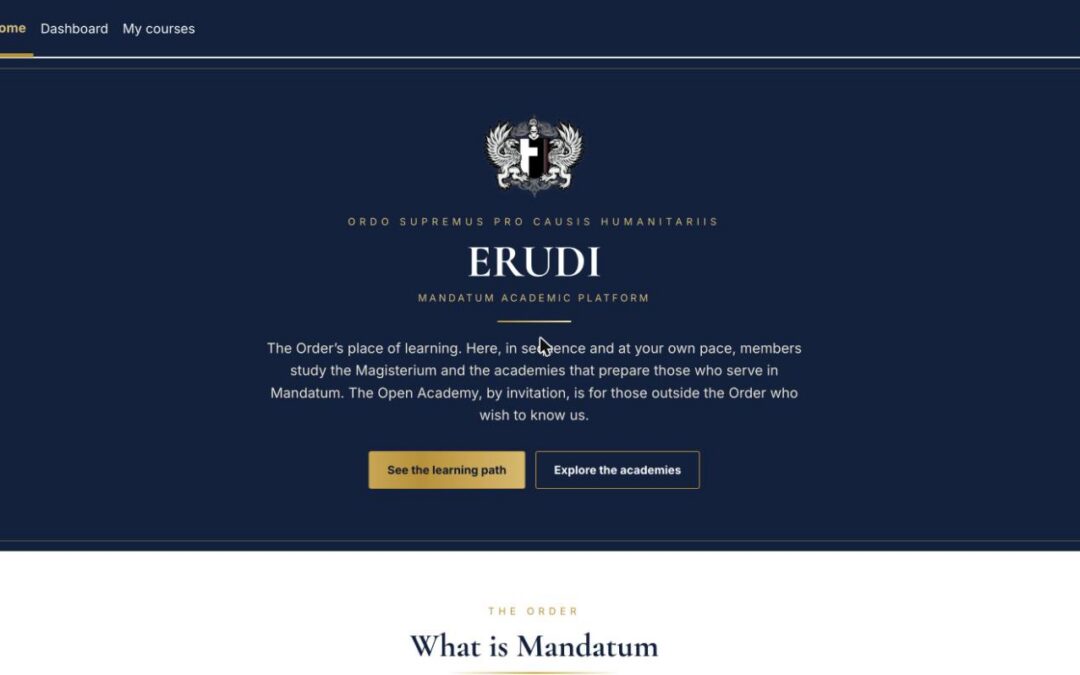
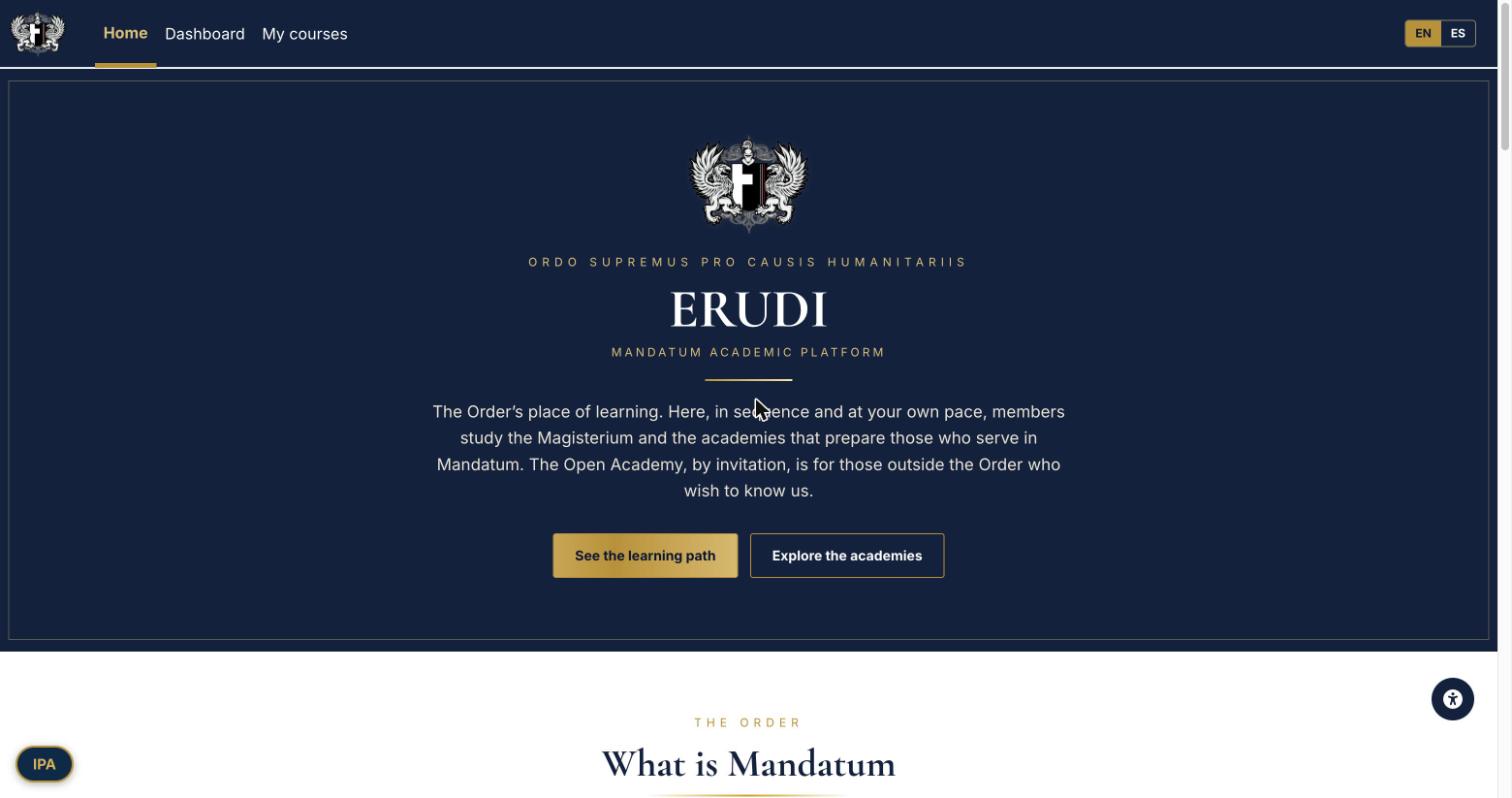
Mandatum now has a new home for learning. ERUDI, the academic platform of the Order, brings the training of its members together in one place, in English and Spanish, with a classic university look.
The ERUDI home page.
Who can sign in
Every member of the Order can sign in to ERUDI with their official email of the Order. There is no separate account to request: members register and sign in with that email. Visitors can browse the front page and the catalog, but courses are taken by signed-in members.
What ERUDI is
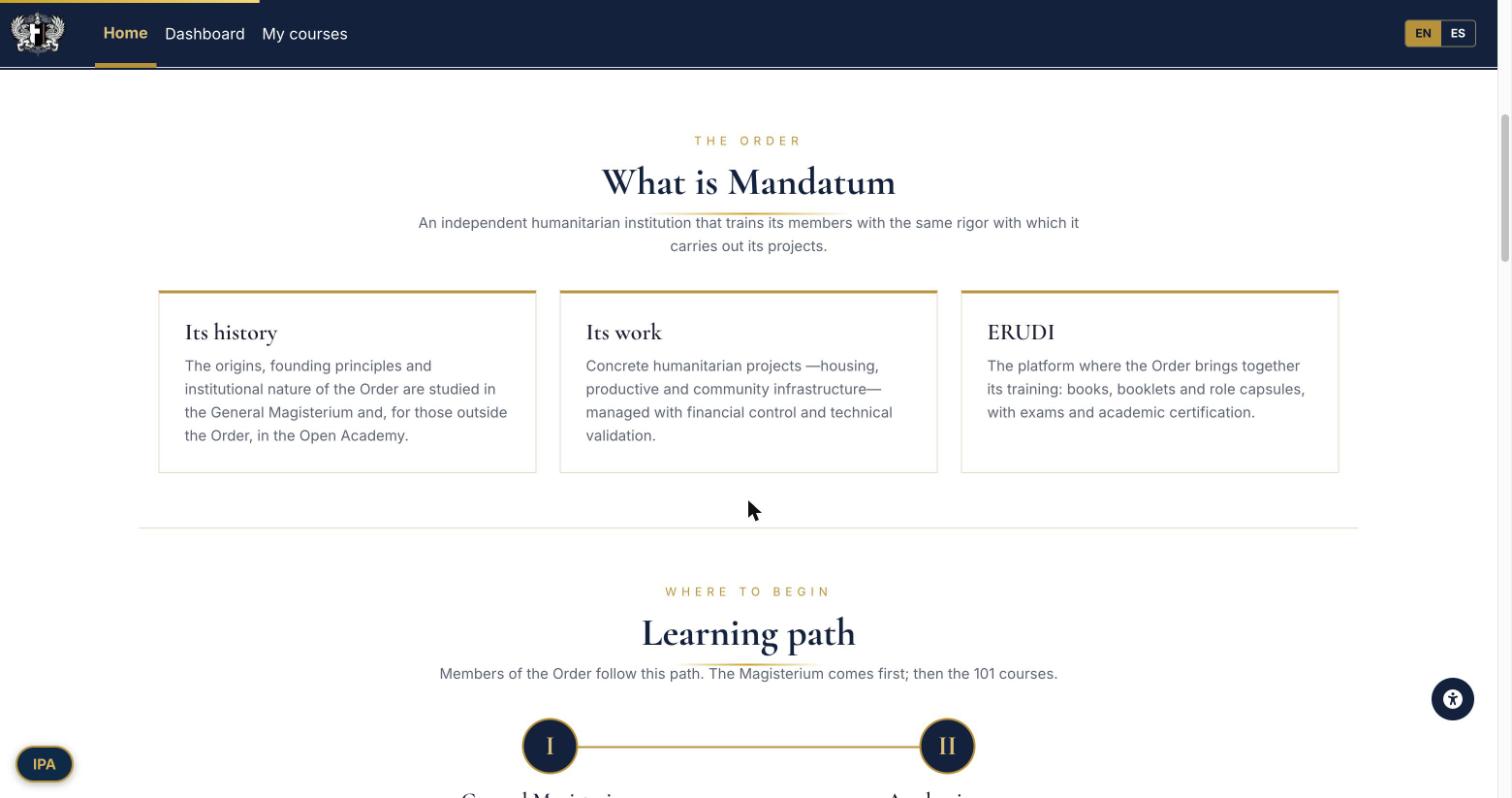
ERUDI is where the Order gathers its training: books, booklets and role capsules, with exams and academic certification. It also explains who Mandatum is, how it works and how its members are prepared to serve.
ERUDI presents the Order, its work and its training.
The learning path
Training follows a clear sequence that members study at their own pace.
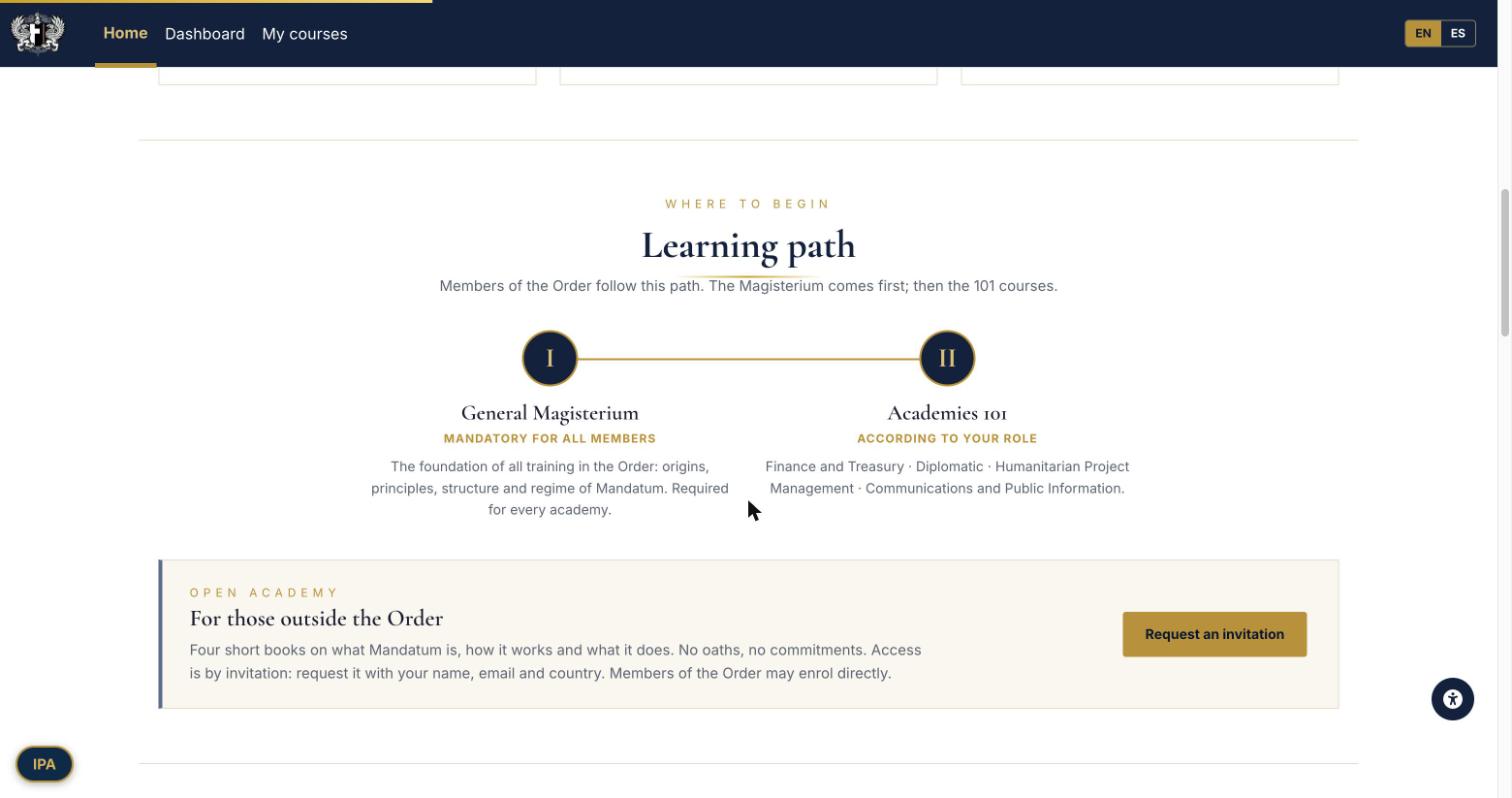
General Magisterium (mandatory for all members). The foundation of all training in the Order: its origins, principles, structure and regime. It must be completed before any academy.
Academies 101 (according to your role). Finance and Treasury, Diplomatic, Humanitarian Project Management, and Communications and Public Information.
The learning path and the Open Academy.
Open Academy, for those outside the Order
People who are not members can get to know Mandatum through the Open Academy: four short books on what Mandatum is, how it works and what it does, with no oaths and no commitments. Access is by invitation, which can be requested on the platform with a name, an email and a country. Members of the Order can enrol directly.
Two languages
ERUDI is available in English and Spanish, with a switch at the top of every page. Courses are kept separate by language, and each person can filter the catalog to the one they need.
Mandatum has drawn up a preliminary concept for a comprehensive rehabilitation, medical training and technology complex in the Republic of Peru. Called the City of Health and Knowledge, it would bring care, teaching and research together on a single 20,000 m² site.
A gap that affects millions
According to Peru's 2017 National Census, about 3.2 million people in the country live with some form of disability, around 10.3% of the population. The national statistics institute (INEI) reports that 88.6% of them receive no treatment or rehabilitation therapy. Specialized services are concentrated in Lima and a few regional capitals, so patients elsewhere often travel long distances for care. The country also lacks enough advanced training in physiotherapy, neuro-rehabilitation and clinical geriatrics.
What the complex would include
Clinical care: four anchor specialties in the first phase, Rehabilitation and Physiotherapy, Traumatology, Neurology and Geriatrics, with room to add Cardiology, Oncology and Pediatrics later. The design assumes an initial capacity of 150 patients per day, growing beyond 300.
A school of medicine: technical programs, postgraduate courses and continuing education, with simulation labs and a biomechanics laboratory.
Housing for professionals: 50 furnished residences for specialists, visiting teachers and key staff.
A business zone: space leased on preferential terms to small local entrepreneurs such as cafés, pharmacies and orthopedic shops.
Technology and communications: an electronic health record, artificial intelligence tools for scheduling and diagnostic support, and an in-house television channel for medical education.
Sustainability: solar panels, rainwater reuse, LED lighting and bioclimatic architecture.
Open to everyone
The plan builds in access for people with fewer resources: free care for vulnerable neighbors, scholarships for medical students from low-income families, agreements with Peru's public health insurers (SIS and EsSalud) and fees scaled to the patient's ability to pay. The complex is also designed for full accessibility.
Built around the four pillars
The project brings Mandatum's four humanitarian pillars together in one place: health in the clinic, education in the school, housing in the staff residences and ecology in the building design. It also aligns with seven of the United Nations Sustainable Development Goals and would create about 300 skilled jobs.
Next steps
This is an early concept, not a final plan. The next stages are to refine the scope with the medical leadership, present the project to the Government of Peru and agree the framework for its development. We will report on progress here.
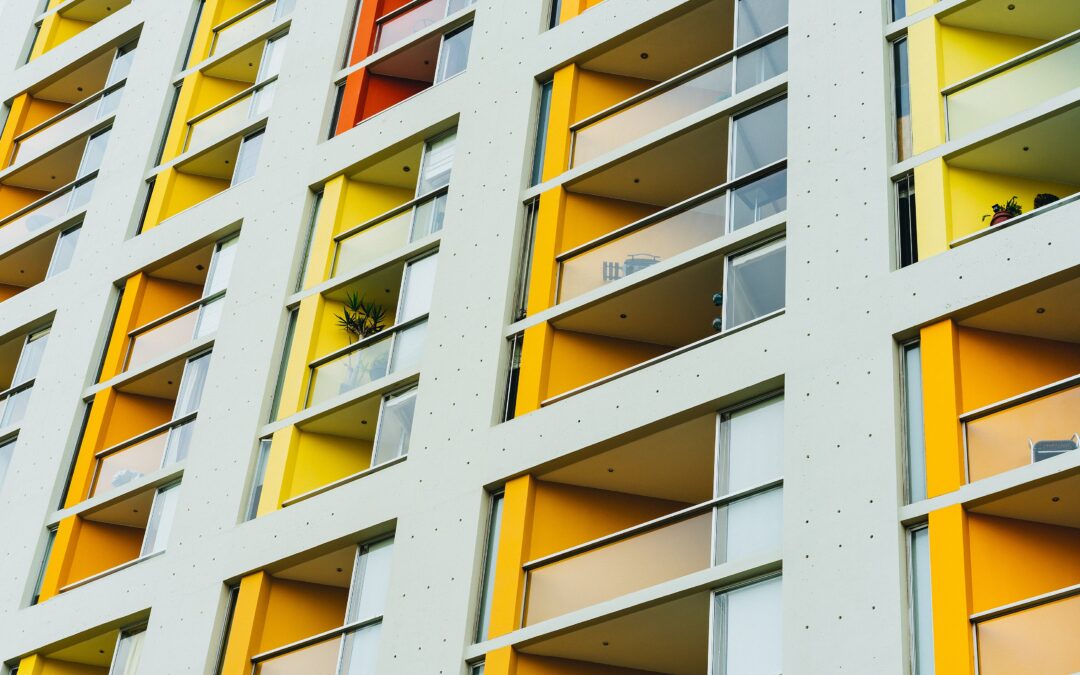
Photo: Miraflores, Lima, Peru (Unsplash, CC0 public domain).
This project has a detailed technical document covering the investment costs, the break-even point, maintenance and operating costs, financing, and ownership structure. The document is available to the members of the Order. Interested members may contact the Chancellery of the Order in their country to request the information.
The crest of Mandatum now has a place on your screen. We are offering two official wallpapers of the Order, one made for phones and one for computers, free to download and use.
More than three quarters of the district of Bocas del Toro, on Panama's Caribbean coast, is protected land. It includes the Isla Bastimentos Marine National Park, mangroves, reefs and rainforest. Roughly 100,000 visitors come every year, yet around half of the homes in the island and rural communities still lack a stable connection to the electric grid, which pushes families to cut mangrove for firewood.
Mandatum is studying an idea for this territory, and it begins with a condition: nothing moves forward without consensus. Any project would need the agreement of the national government, the local government and the Indigenous peoples of the area, with prior, free and informed consent before any work begins. If that agreement is not reached, Mandatum withdraws.
The concept is a low-impact ecological complex, built only on the portion of the district that is not protected. Buildings would stay at three floors or fewer, use local and low-carbon materials, and run entirely on renewable energy, with full management of water and waste and independent environmental certification.
The model places local people first. Priority would go to hiring from the community. Restaurants, shops, tours and transport would be run by local micro-entrepreneurs, trained and incubated through the project itself. Housing for local workers and families, clean energy, drinking water and sanitation would serve visitors and residents alike, and help close the electrification gap that drives mangrove cutting.
The aim is a replicable example of development that is ecologically and economically sustainable, supporting the population of the territory instead of displacing it. As an early-stage concept it can be adapted, or changed entirely, as many times as needed to reach a version that the people of Bocas del Toro actually want.
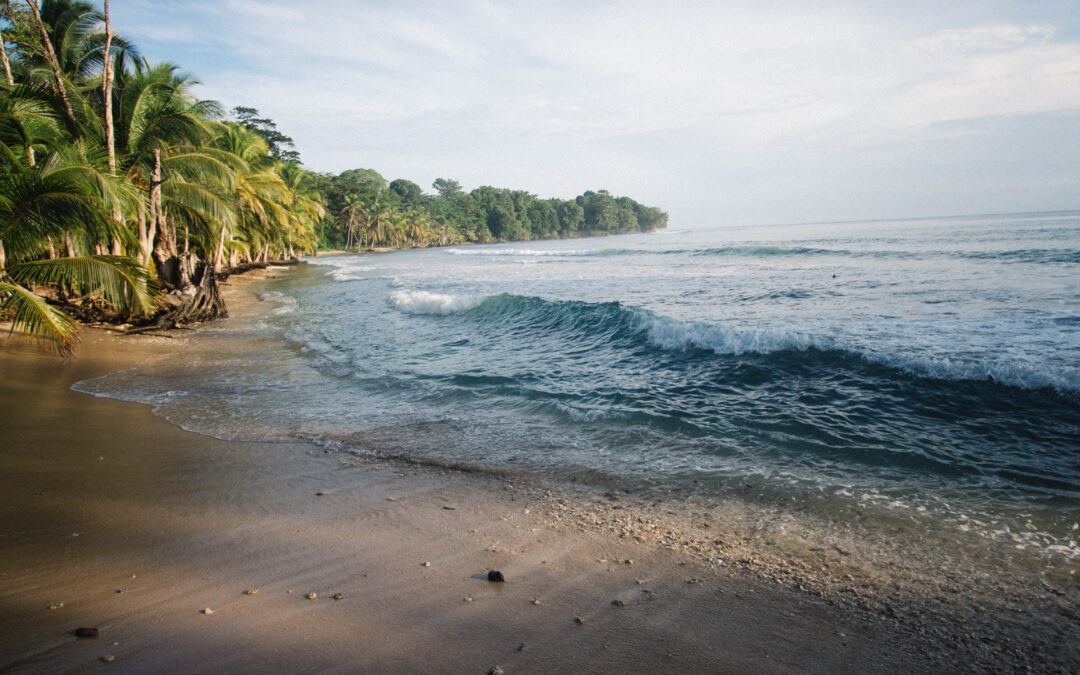
Photo: Bocas del Toro, Panama. Unsplash, CC0 (public domain), via Wikimedia Commons.
This project has a detailed technical document covering the investment costs, the break-even point, maintenance and operating costs, financing, and ownership structure. The document is available to the members of the Order. Interested members may contact the Chancellery of the Order in their country to request the information.
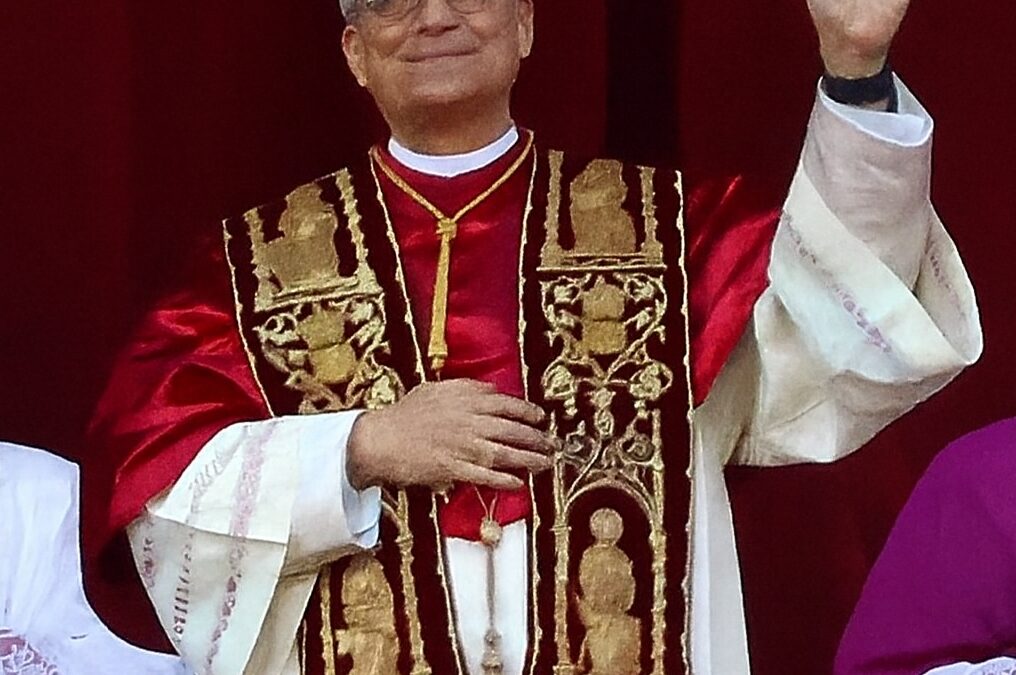
Three days after lung cancer surgery, Pope Leo XIV picked up the telephone from his room at Rome's Gemelli Hospital and called Russian President Vladimir Putin. The conversation took place on October 16, 2026, and the Vatican confirmed it in a note to the press.
The Holy Father had one request: a ceasefire so that food and medical aid could reach Oleshky, a city in Ukraine's Kherson region, and so that civilians who wish to leave could do so safely. Oleshky lies in a front-line zone where, according to Ukrainian religious leaders, residents have been cut off from supplies for months. Those leaders had appealed to the Pope and other faith leaders in September to intervene.
The Vatican said Leo XIV also reaffirmed the Holy See's commitment to dialogue and peace. According to the Kremlin, as reported by Reuters, the call was constructive, Putin wished the Pope a speedy recovery, and both sides agreed to cooperate on delivering aid. The Kremlin also blamed Kyiv for the situation in the city, a claim Ukraine rejects.
It was the second conversation between the two men since the Pope's election, after one in June 2025. The same day, Leo XIV issued a World Food Day message declaring access to sufficient food a basic human right.
The gesture says something about this pontificate: a Pope recovering from major surgery who still spends his strength on people he has never met. For those trapped in Oleshky, what matters now is whether words become convoys.
Sources: Holy See Press Office, via America Magazine and National Catholic Reporter; Reuters (Kremlin account). Photo: Edgar Beltrán / The Pillar, CC BY-SA 4.0, via Wikimedia Commons.
 Barça
 Peñarol
 Inter Miami