Under its name, the Mandatum Herald carries a motto in Latin: Vox Populi, Vox Dei, “the voice of the people is the voice of God.” It reads like a confident slogan. Its history is more interesting, because the earliest known writer to put those words together did so as a warning.
A letter to an emperor
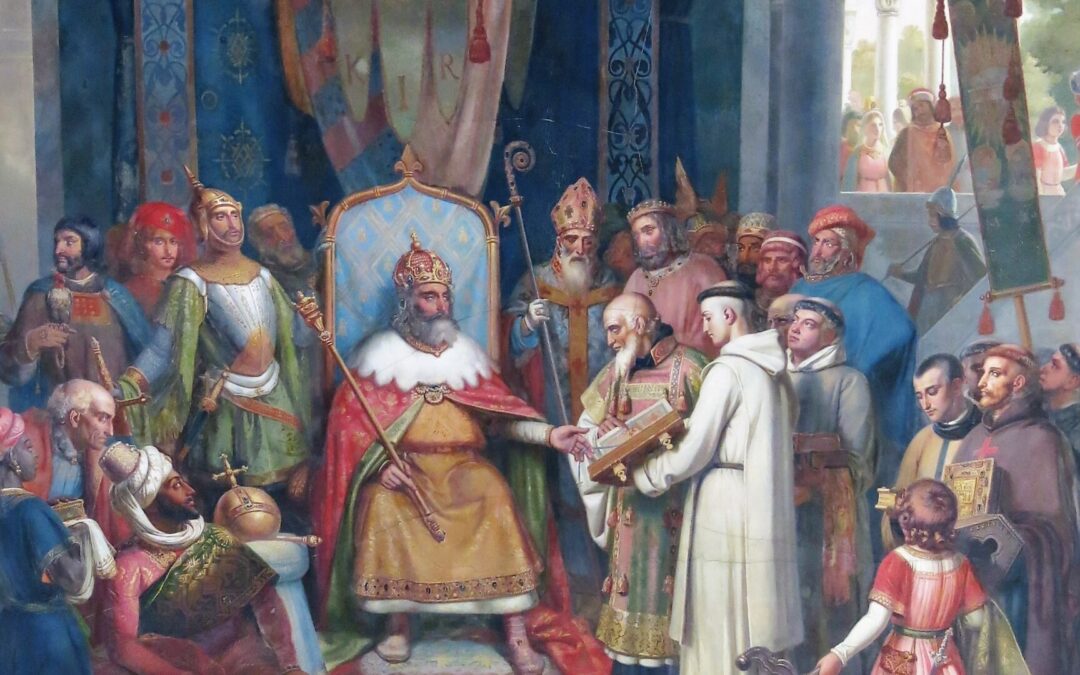
Alcuin of York was an Anglo-Saxon scholar who led Charlemagne’s Palace School at Aachen. In a letter to the emperor, dated to about the year 798 or 800, he cautioned against those who keep repeating that the voice of the people is the voice of God. In his view, the restlessness of a crowd is always very close to madness, so a ruler should not take its noise for a guide.
A proverb that changed sides
The saying outlived the warning. In 1327 Archbishop Walter Reynolds preached on it while justifying the deposition of Edward II. In 1706 the philosopher John Locke rejected it, writing that God does not deliver his oracles through the multitude. Over time, in English, the phrase came to mean simply the opinion of the majority.
In 1907 the statistician Francis Galton gave it a famous modern test. Writing in Nature under the title “Vox Populi,” he used a weight-judging contest at a country fair to show how the combined guess of a crowd can be remarkably accurate.
From the crowd to the newsroom
Journalists borrowed the first half of the phrase. A “vox pop” is a short interview with ordinary, unselected people, the classic “man on the street.” It is not a survey. Its purpose is to let a range of voices be heard, from different ages, backgrounds and communities.
A motto worth reading carefully
Read with Alcuin in mind, the motto asks for more than applause. Listening to the people is a duty, and so is judging what is heard with care, with facts and with conscience. That is a fair standard for a newspaper to set for itself.
Sources: Wikipedia, “Vox populi”; HistoryNet, “What Is the History of Vox Populi, Vox Dei?” Image: painting of Charlemagne receiving Alcuin, public domain, via Wikimedia Commons.
Doctors have confirmed that Pope Leo XIV is cancer-free. He underwent surgery on October 13 to remove a tumor from his right lung. Medical officials said the tests showed the cancer was localized and had been completely removed, and that he will not need chemotherapy or any further treatment. Church leaders say he is recovering well.
Back in St. Peter’s Square
On Wednesday, October 21, the Pope resumed his general audiences. Before the catechesis he rode through St. Peter’s Square in the popemobile and blessed babies brought to him. His greetings to groups and guests were shorter than usual, in order to protect his rest during recovery.
A catechesis on married love
The audience was devoted to marriage and the family. The Pope said married love goes beyond physical attraction: it involves the whole commitment of the couple, shows itself in tenderness and shapes their entire life together. He stressed that husband and wife are equal in dignity.
Drawing on the Second Vatican Council’s Gaudium et Spes, he said married love is fruitful, including in the gift of children. He restated the Church’s teaching that life must be protected from the moment of conception. He called the family the foundation of society and a place where people learn to become more fully human, and he urged those with public responsibility to support families, a task he described as more urgent than ever.
What comes next
The Pope is expected to resume his public duties gradually. No timetable has been given.
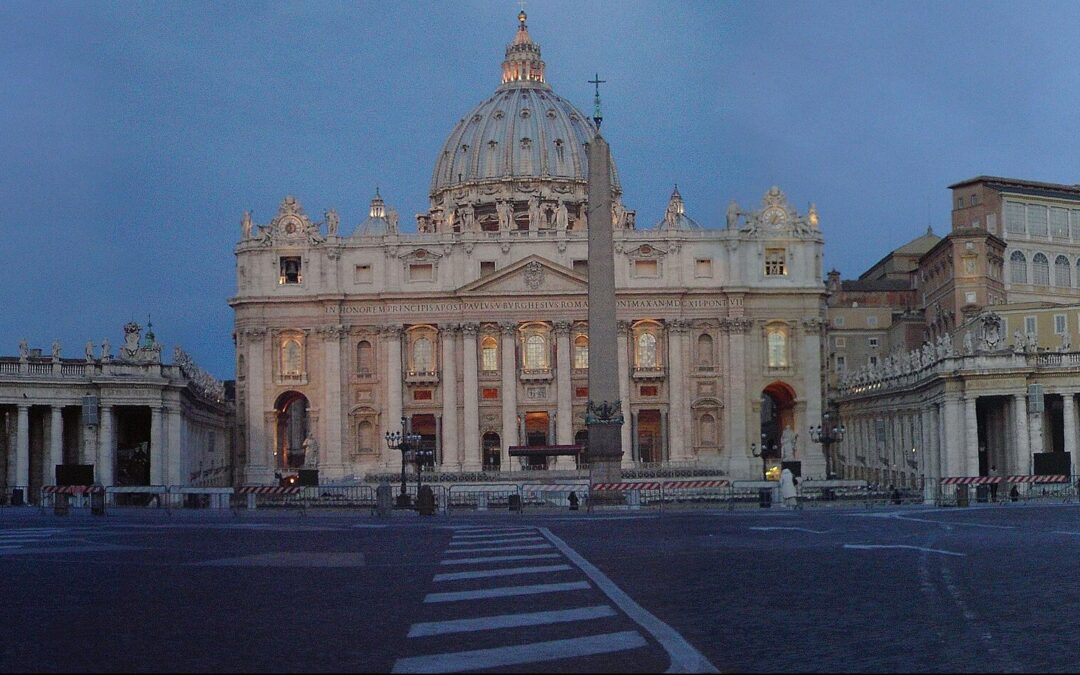
Sources: WJR, “Doctors Confirm Pope Leo XIV Is Cancer-Free After Surgery” (October 22, 2026); Rome Reports, “Pope Leo XIV resumed his Wednesday audiences, speaking about love and the family” (October 21, 2026). Image: St. Peter’s Square at dusk, public domain, via Wikimedia Commons.
Mandatum has prepared a technical profile for memorial parks in Peru: permanent sites for dignified burial, built to a high standard of design, security and perpetual care. The profile is a reference model, not tied to a specific plot of land. It explains, step by step, how such a park would be designed, built and operated.
Why it matters
A dignified burial is a basic human need and a public health matter. Where cemeteries are saturated or informal, the risks to soil and water increase, and families with fewer resources are left without a dignified option. Local mortality figures and existing capacity would be gathered in the first phase of the project.
Buildings: a Catholic chapel, a multi-faith chapel, wake rooms, administration offices, an infirmary, a crematorium, visitor services and a maintenance block.
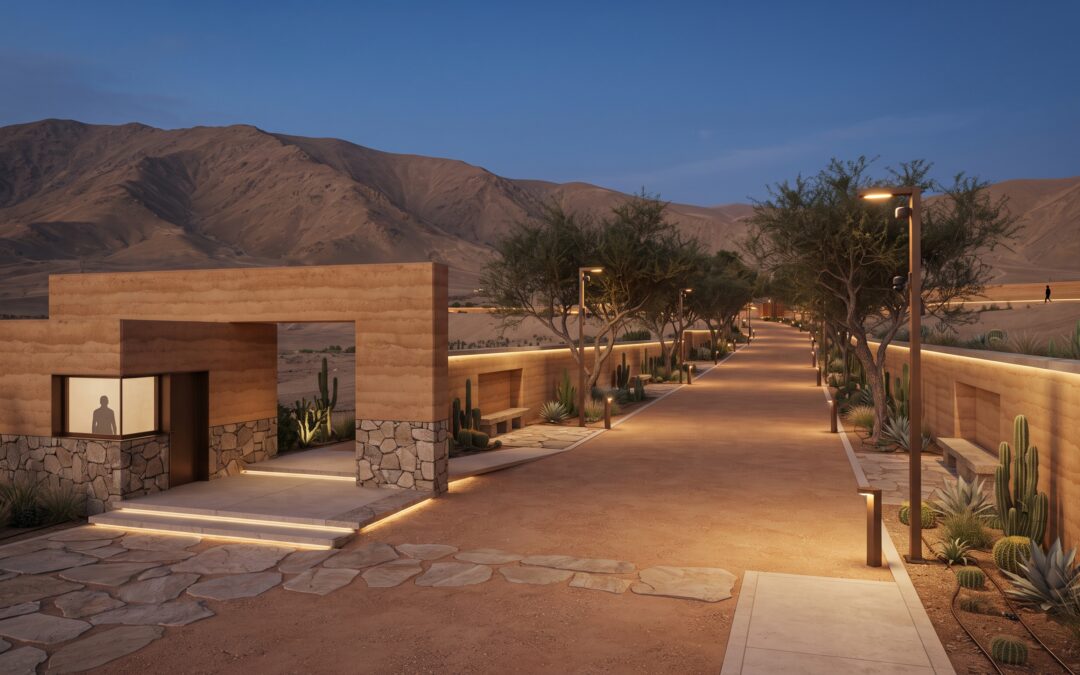
Landscape: gentle terraces that follow the terrain, native low-water planting, drip irrigation, solar power and reuse of treated water.
How the model works
Mandatum leads and develops the project in full.
There is no cost, debt or guarantee for the State at any stage.
The park’s own revenue covers operation, maintenance, renewal and perpetual care, and its administration stays with Mandatum to guarantee continuity.
A social burial sector offers the same quality of service to people living in poverty, supported by cross-subsidy.
The project stays open to the Government’s priorities and can be redirected toward other projects.
Built in phases
The park grows module by module, so each phase is financed and operated on its own. The project moves through five phases, and each one is confirmed before the next begins:
Phase 0: first contact and expression of interest.
Phase 1: site selection, demand study and technical studies.
Phase 2: preliminary design, budget and permits.
Phase 3: construction by modules of one to two hectares.
Phase 4: opening, direct administration by Mandatum and perpetual care.
Designed for safety and resilience
The design follows Peru’s seismic standard (E.030), with drainage sized for intense rain and raised burial sectors or niches wherever the water table is high. Security includes a perimeter wall, access control, video surveillance, night lighting and round-the-clock monitoring. Construction milestones are certified by an independent technical entity before each payment is authorized.
What Mandatum asks of local counterparts
At this stage Mandatum asks for no money and no guarantees. It asks to confirm the need for dignified burial space and propose candidate sites, to name a technical contact, to agree a technical meeting to present the model and hear local priorities, and to receive guidance on the applicable procedures: land use, health licensing and environmental assessment.
All figures are reference design criteria, subject to validation by Peruvian engineers, the general contractor and local regulations. Any images shown for this project are illustrative renders and do not represent a real or final project.
This project has a detailed technical document covering the investment costs, the break-even point, maintenance and operating costs, financing, and ownership structure. The document is available to the members of the Order. Interested members may contact the Chancellery of the Order in their country to request the information.
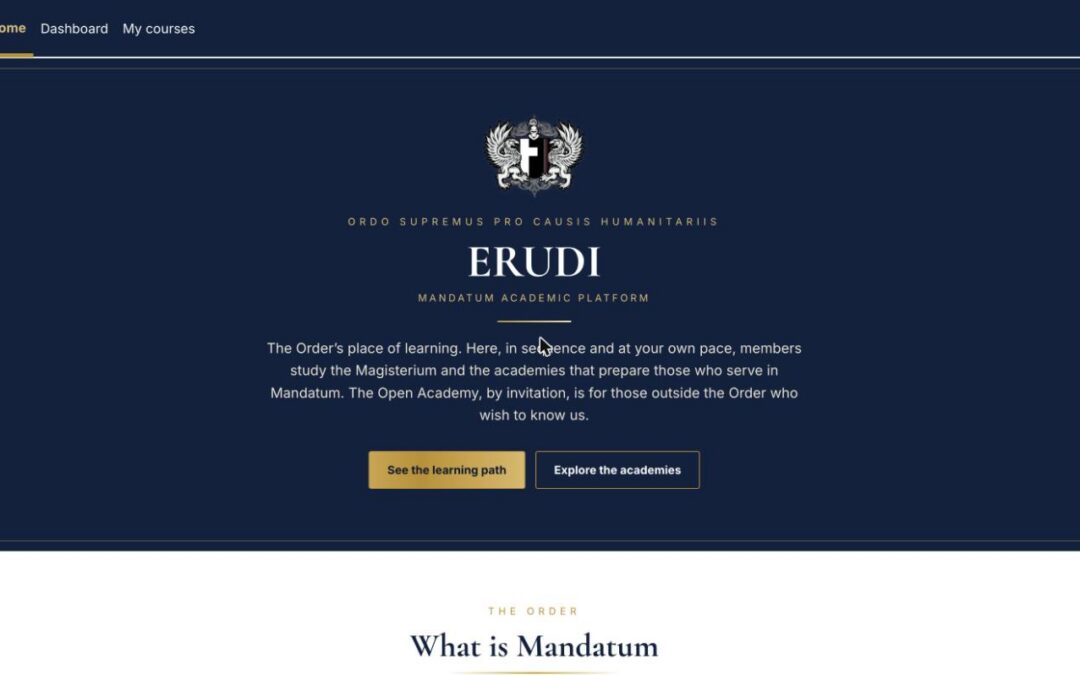
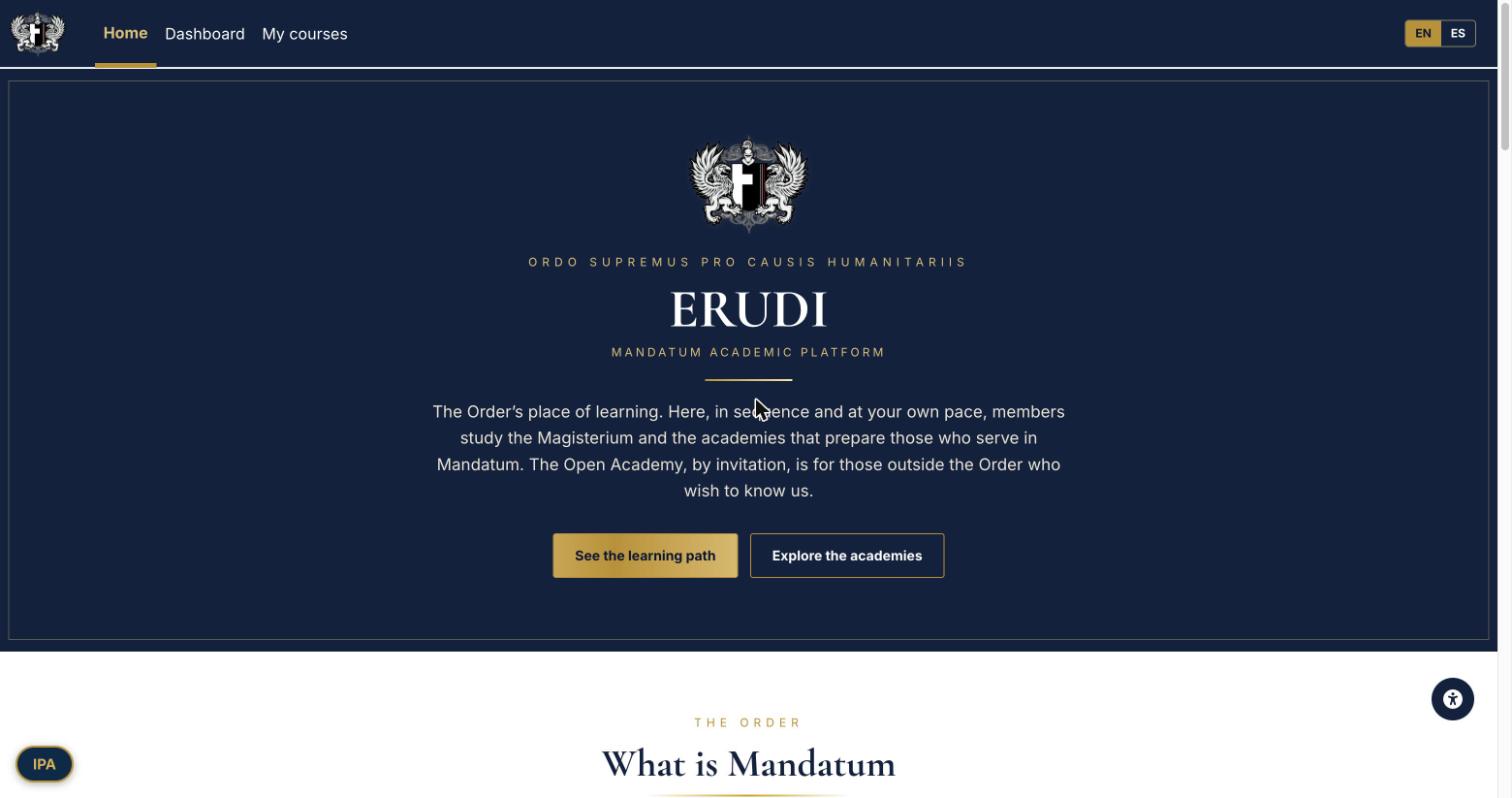
Mandatum now has a new home for learning. ERUDI, the academic platform of the Order, brings the training of its members together in one place, in English and Spanish, with a classic university look.
The ERUDI home page.
Who can sign in
Every member of the Order can sign in to ERUDI with their official email of the Order. There is no separate account to request: members register and sign in with that email. Visitors can browse the front page and the catalog, but courses are taken by signed-in members.
What ERUDI is
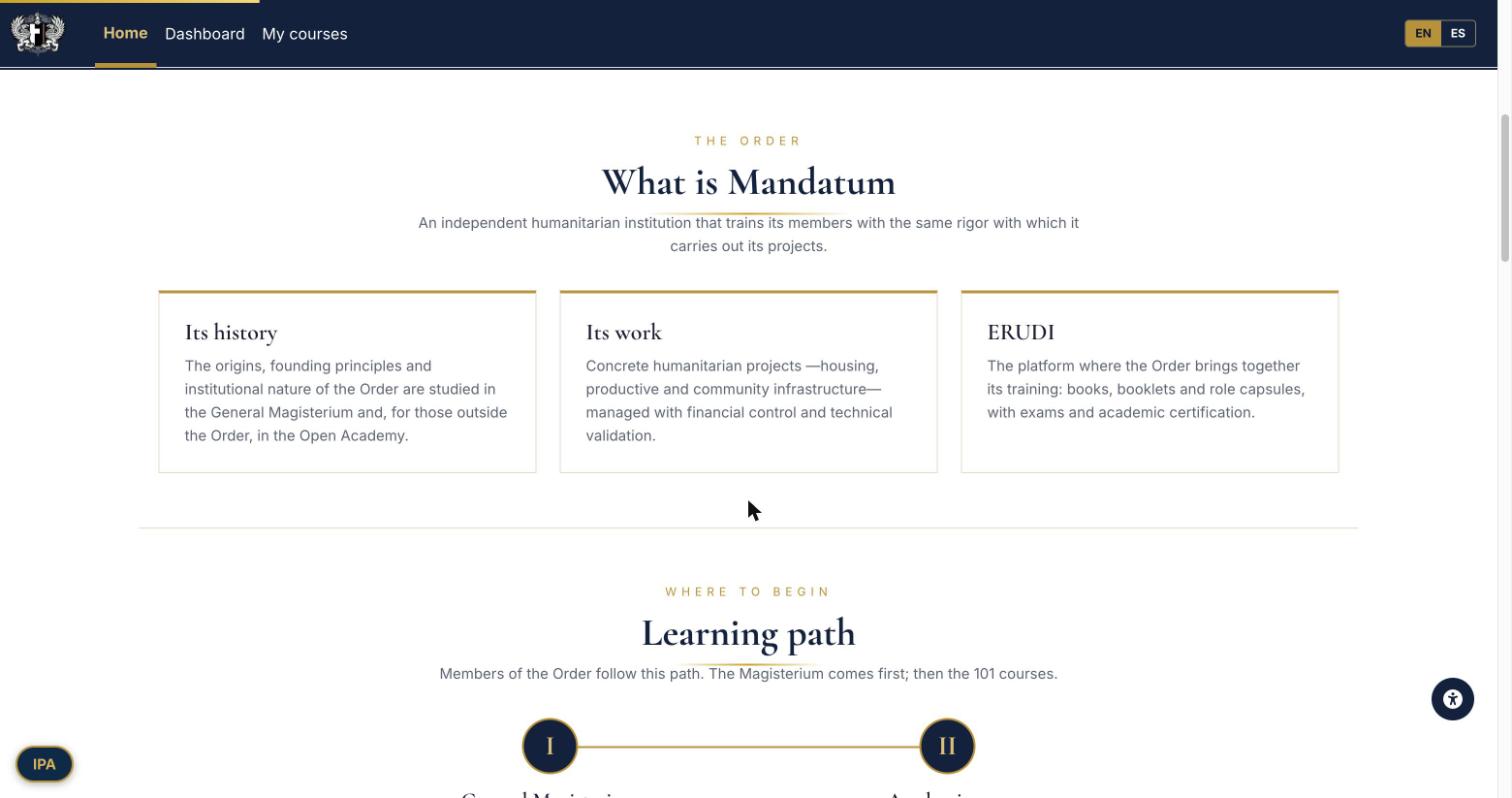
ERUDI is where the Order gathers its training: books, booklets and role capsules, with exams and academic certification. It also explains who Mandatum is, how it works and how its members are prepared to serve.
ERUDI presents the Order, its work and its training.
The learning path
Training follows a clear sequence that members study at their own pace.
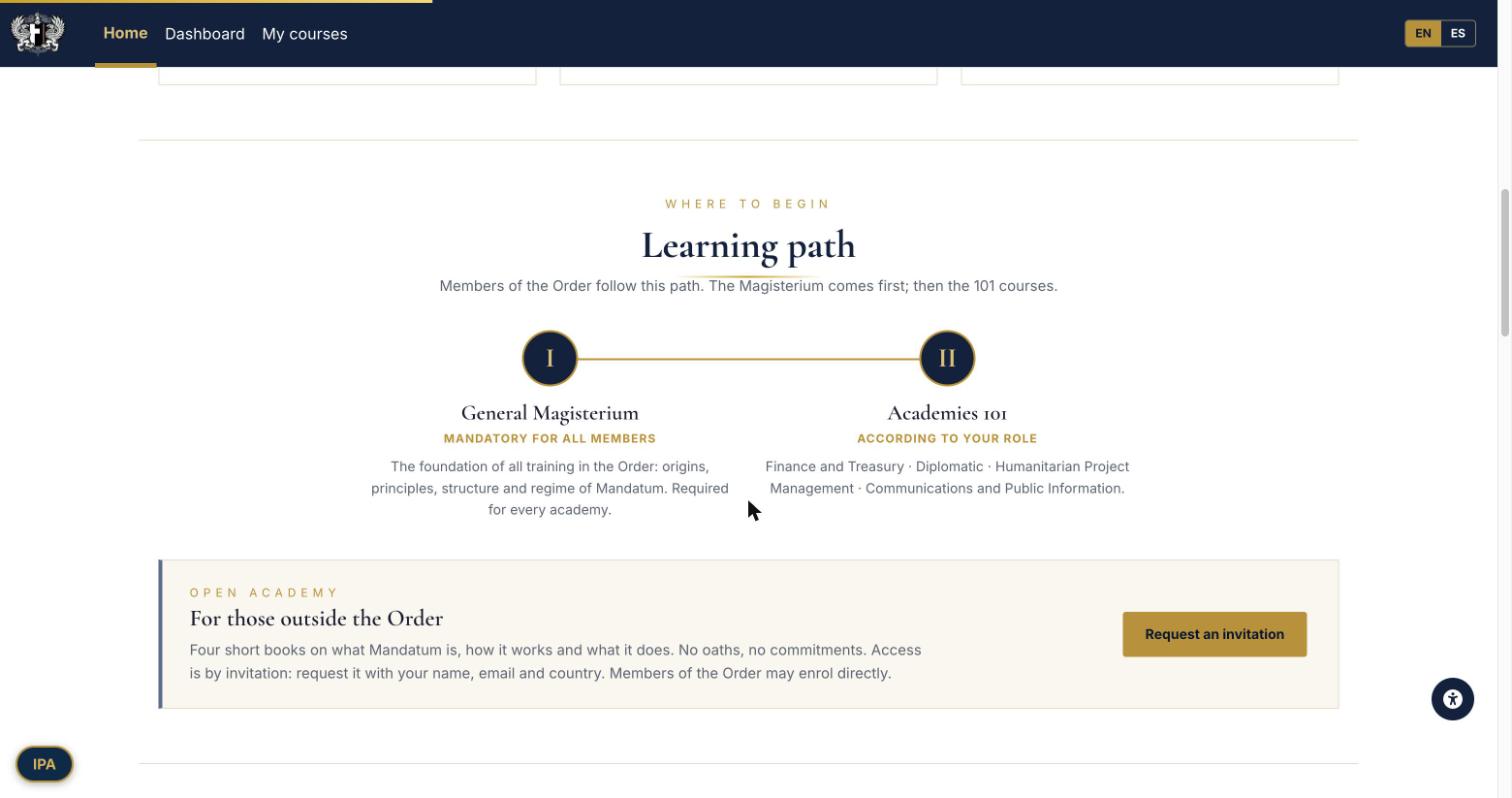
General Magisterium (mandatory for all members). The foundation of all training in the Order: its origins, principles, structure and regime. It must be completed before any academy.
Academies 101 (according to your role). Finance and Treasury, Diplomatic, Humanitarian Project Management, and Communications and Public Information.
The learning path and the Open Academy.
Open Academy, for those outside the Order
People who are not members can get to know Mandatum through the Open Academy: four short books on what Mandatum is, how it works and what it does, with no oaths and no commitments. Access is by invitation, which can be requested on the platform with a name, an email and a country. Members of the Order can enrol directly.
Two languages
ERUDI is available in English and Spanish, with a switch at the top of every page. Courses are kept separate by language, and each person can filter the catalog to the one they need.
Mandatum has drawn up a preliminary concept for a comprehensive rehabilitation, medical training and technology complex in the Republic of Peru. Called the City of Health and Knowledge, it would bring care, teaching and research together on a single 20,000 m² site.
A gap that affects millions
According to Peru's 2017 National Census, about 3.2 million people in the country live with some form of disability, around 10.3% of the population. The national statistics institute (INEI) reports that 88.6% of them receive no treatment or rehabilitation therapy. Specialized services are concentrated in Lima and a few regional capitals, so patients elsewhere often travel long distances for care. The country also lacks enough advanced training in physiotherapy, neuro-rehabilitation and clinical geriatrics.
What the complex would include
Clinical care: four anchor specialties in the first phase, Rehabilitation and Physiotherapy, Traumatology, Neurology and Geriatrics, with room to add Cardiology, Oncology and Pediatrics later. The design assumes an initial capacity of 150 patients per day, growing beyond 300.
A school of medicine: technical programs, postgraduate courses and continuing education, with simulation labs and a biomechanics laboratory.
Housing for professionals: 50 furnished residences for specialists, visiting teachers and key staff.
A business zone: space leased on preferential terms to small local entrepreneurs such as cafés, pharmacies and orthopedic shops.
Technology and communications: an electronic health record, artificial intelligence tools for scheduling and diagnostic support, and an in-house television channel for medical education.
Sustainability: solar panels, rainwater reuse, LED lighting and bioclimatic architecture.
Open to everyone
The plan builds in access for people with fewer resources: free care for vulnerable neighbors, scholarships for medical students from low-income families, agreements with Peru's public health insurers (SIS and EsSalud) and fees scaled to the patient's ability to pay. The complex is also designed for full accessibility.
Built around the four pillars
The project brings Mandatum's four humanitarian pillars together in one place: health in the clinic, education in the school, housing in the staff residences and ecology in the building design. It also aligns with seven of the United Nations Sustainable Development Goals and would create about 300 skilled jobs.
Next steps
This is an early concept, not a final plan. The next stages are to refine the scope with the medical leadership, present the project to the Government of Peru and agree the framework for its development. We will report on progress here.
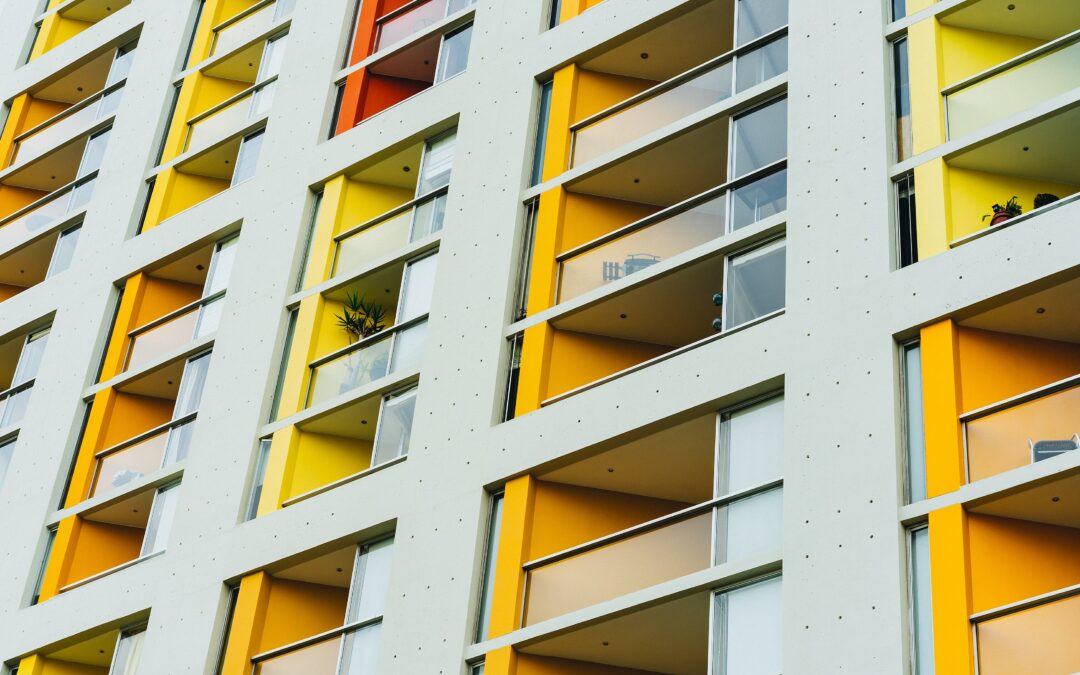
Photo: Miraflores, Lima, Peru (Unsplash, CC0 public domain).
This project has a detailed technical document covering the investment costs, the break-even point, maintenance and operating costs, financing, and ownership structure. The document is available to the members of the Order. Interested members may contact the Chancellery of the Order in their country to request the information.
 Barça
Barça Peñarol
 Inter Miami