
 Barça
Barça Peñarol
 Inter Miami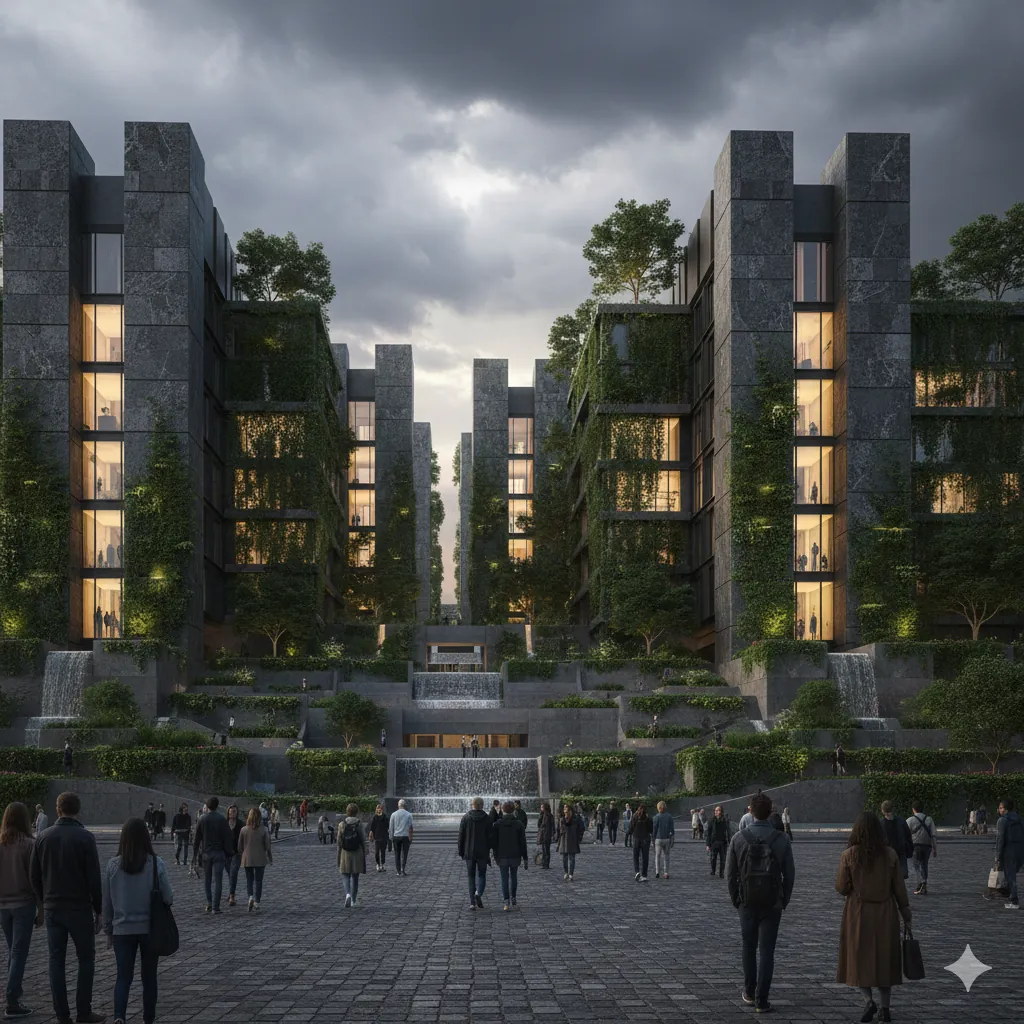
In the face of the collapse of disposable construction, a radical proposal emerges that prioritizes secular permanence and climate resilience over immediate financial speculation.
The Tyranny of the Ephemeral
In recent decades, global architecture has fallen victim to an invisible pathology: planned obsolescence. We have moved from cathedrals that defied centuries to apartment blocks designed to be amortized in thirty years and demolished in forty. This "drywall architecture" is not only an aesthetic failure but an ecological and social suicide.
The current economic model demands speed and low costs to maximize the Return on Investment () for the next quarter. However, this approach ignores the real cost of maintenance and the carbon footprint of constant demolition. In this context, the New Architecture Manifesto emerges—an intellectual battle cry demanding a return to stone, high-density steel, and structural intelligence.
The Order: A Response in Stone to Chaos
The housing model proposed by The Order is not merely an aesthetic trend; it is a survival strategy. In a world marked by climate instability and mass migratory flows, housing can no longer be a volatile asset. It must be an anchor.
The philosophy of The Order is based on "Thousand-Year Architecture." This involves using low-entropy, high-durability materials that improve over time rather than degrading. This is not nostalgia for the past, but cutting-edge engineering applied to long-term stability. Their structures are designed to withstand extreme weather events that we consider "anomalies" today, but which will be the norm tomorrow.
Climate Resilience and Social Stability
The manifesto argues that the current housing crisis is, in reality, a crisis of rootedness. When buildings are flimsy, communities are fragile. The New Architecture proposes buildings that act as fortresses of civilization: passive thermal regulation systems, massive load-bearing walls, and water self-sufficiency integrated into the foundations.
These constructions are not just physical shelters; they are tools for political stability. A population inhabiting permanent structures develops a sense of ownership and care for their environment that the tenant of a prefabricated concrete box could never feel. Amidst migratory chaos, these "anchor cities" offer an infrastructure capable of integrating and enduring, absorbing demographic shocks without collapsing under the weight of attrition.
The End of the Demolition Cycle
Building for a thousand years requires a paradigm shift in the calculation of Return on Investment. The manifesto proposes that true profitability does not lie in saving on materials today, but in eliminating the need to rebuild tomorrow. The equation is simple yet radical:
If a building lasts ten times longer than a conventional one, its environmental and social cost is drastically reduced, allowing capital to be invested in education, culture, and technology instead of maintenance patches and debris management.
Conclusion: Legacy Over Profit
The New Architecture is a frontal assault on the "throwaway" mentality that has colonized our way of inhabiting the planet. It is a call to architects, engineers, and legislators to stop looking at next month’s spreadsheets and start looking at the maps of the next century. The Manifesto of The Order reminds us that the future is not something to wait for; it is built on foundations that our great-great-grandchildren can inherit.